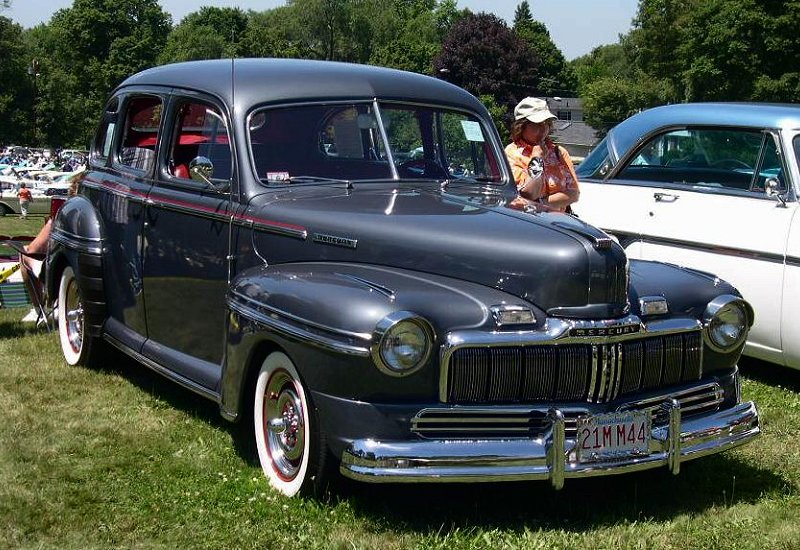
Description
The Mercury Eight Sedan 79M was part of Mercury’s immediate pre-war and early wartime model range and reflected the brand’s role as a more refined and substantial alternative to Ford. The 79M designation identified a specific model-year series within the Mercury Eight lineup, produced during the early 1940s, and combined smooth V8 performance with distinctive styling that set Mercury apart in the mid-priced American market.
The Mercury Eight had been introduced in 1939 to bridge the gap between Ford and Lincoln, offering buyers greater size, comfort and presence without entering full luxury territory. By the time the 79M series appeared, the car had developed a strong identity, with broader proportions and more substantial trim than its Ford counterpart. The styling reflected early-1940s American design themes, featuring a tall, chrome-accented grille, flowing front fenders and a rounded rear profile. Compared with Ford models of the same period, the Mercury presented a longer wheelbase and a more imposing stance.
Power came from a flathead V8 engine, typically the 239 cubic inch unit shared within the Ford Motor Company family but tuned to suit Mercury’s positioning. The engine delivered smooth, steady torque rather than high performance, making it well suited to relaxed cruising and everyday driving. The flathead V8 was known for its simplicity, reliability and ease of maintenance, qualities that were particularly valued during the early 1940s. A manual transmission was standard, offering straightforward operation and dependable service.
The chassis followed conventional American body-on-frame construction, providing strength and durability. Independent front suspension improved ride comfort compared with older designs, while the solid rear axle and leaf springs ensured robustness. The Mercury Eight Sedan 79M was engineered for comfort and stability rather than sharp handling, aligning with buyer expectations of the era.
Inside, the Mercury offered a noticeable step up in refinement compared with Ford. Upholstery materials were of higher quality, trim details were more decorative and the cabin provided generous space for passengers. The dashboard featured clear instrumentation and chrome highlights, contributing to a sense of solidity and understated elegance. Seating was broad and supportive, designed to accommodate families and long-distance travel comfortably.
The historical context of the 79M series is significant. Production during the early 1940s was eventually curtailed as American industry shifted toward wartime manufacturing. As a result, Mercury models from this period occupy an important place in pre-war automotive history, representing the final generation of American passenger cars built before civilian production paused during World War II.
Today, the Mercury Eight Sedan 79M is regarded as a classic example of early-1940s American automotive design. Its flowing lines, dependable flathead V8 and solid construction make it attractive to collectors who appreciate the character of pre-war vehicles. As a historical model, the 79M reflects Mercury’s original mission: to offer more presence and refinement than Ford while remaining accessible to middle-class buyers during a pivotal period in automotive and world history.