Description
The Mercedes-Benz W196 Silberpfeil was one of the most important and dominant Grand Prix racing cars of the 1950s and stood at the heart of Mercedes-Benz’s legendary Silver Arrow era. Developed for the 2.5-litre Formula One regulations, the W196 combined advanced engineering, scientific development and exceptional reliability, redefining what a Grand Prix car could be at the highest level of international motorsport.
Introduced in 1954, the W196 was engineered with an uncompromising focus on efficiency and performance. Power came from a 2.5-litre straight-eight engine mounted at an angle to lower the centre of gravity. The engine featured direct fuel injection, a technology derived from Mercedes-Benz aircraft engineering, giving it a significant advantage over carburettor-fed rivals. Output was around 250 horsepower, remarkable for the period, and delivered with smoothness and consistency across the rev range.
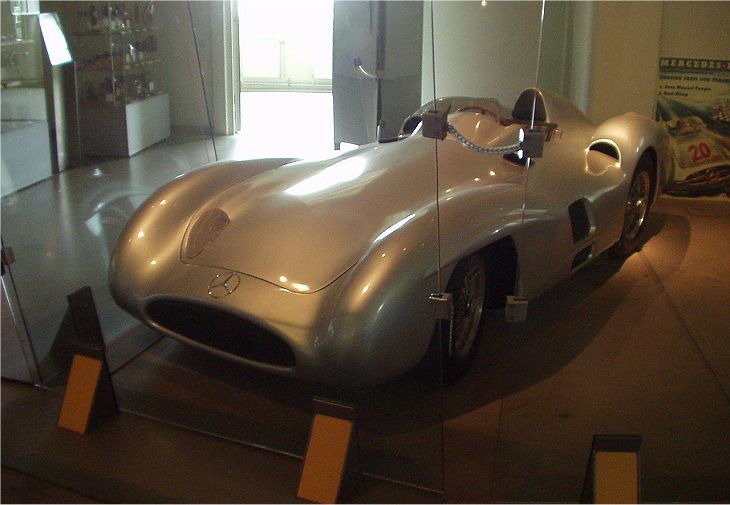
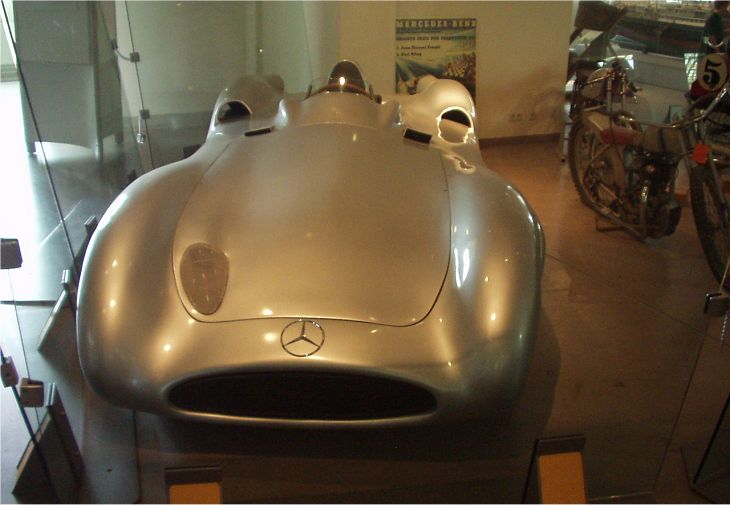
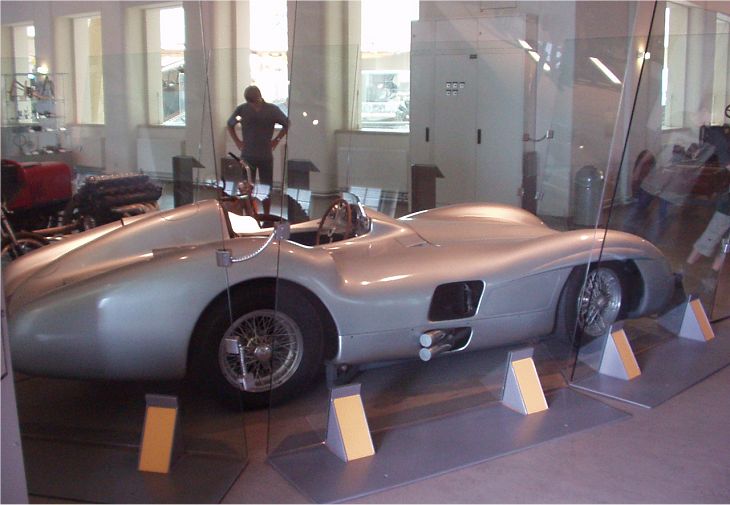
The W196 was produced in two distinct body forms: the open-wheel version and the fully enclosed Stromlinien configuration. Together, these variants formed the core of the Silver Arrow identity during the mid-1950s. The open-wheel car was better suited to technical circuits, while the streamlined version excelled on fast tracks. This flexibility allowed Mercedes-Benz to tailor the car to specific circuits, a strategic advantage rarely matched at the time.
The chassis was a lightweight tubular spaceframe designed for rigidity and precision. Suspension was fully independent front and rear, offering superior road holding compared with many contemporaries. Inboard rear brakes were used to reduce unsprung mass, improving both handling and reliability. Every component was designed with endurance and mechanical sympathy in mind, reflecting Mercedes-Benz’s methodical engineering approach.
The W196 Silberpfeil demanded skill and discipline from its drivers. Narrow tyres, high speeds and limited safety measures made it a challenging car to exploit fully. However, in the hands of elite drivers, it proved devastatingly effective. The car is inseparably associated with Juan Manuel Fangio, who used the W196 to win the Formula One World Championship in both 1954 and 1955. Stirling Moss also achieved notable success with the car, further reinforcing its legendary status.
On the track, the W196 was characterised by its composure and reliability. While some rivals relied on brute force or lightweight construction, the Mercedes-Benz focused on balance, efficiency and sustained performance. This philosophy allowed the W196 to dominate races through consistency as much as outright speed, often finishing strongly when competitors faltered.
The nickname Silberpfeil, or Silver Arrow, was more than a colour or branding exercise. The exposed aluminium bodywork, left unpainted to save weight, became a symbol of German engineering precision and performance. The W196 carried this legacy forward, becoming one of the defining Silver Arrows of motorsport history.
Beyond its competitive success, the Mercedes-Benz W196 Silberpfeil had a profound influence on the future of racing car design. Its use of fuel injection, aerodynamic thinking and systematic engineering development set new standards for Formula One and demonstrated how advanced technology could be translated into competitive advantage.
Today, the Mercedes-Benz W196 Silberpfeil is regarded as one of the greatest racing cars ever built. Surviving examples are among the most valuable and historically significant competition cars in existence. As a symbol of Mercedes-Benz’s golden era in Grand Prix racing, the W196 represents the perfect union of engineering excellence, strategic thinking and driving brilliance, securing its place as a true icon of motorsport history.