Description
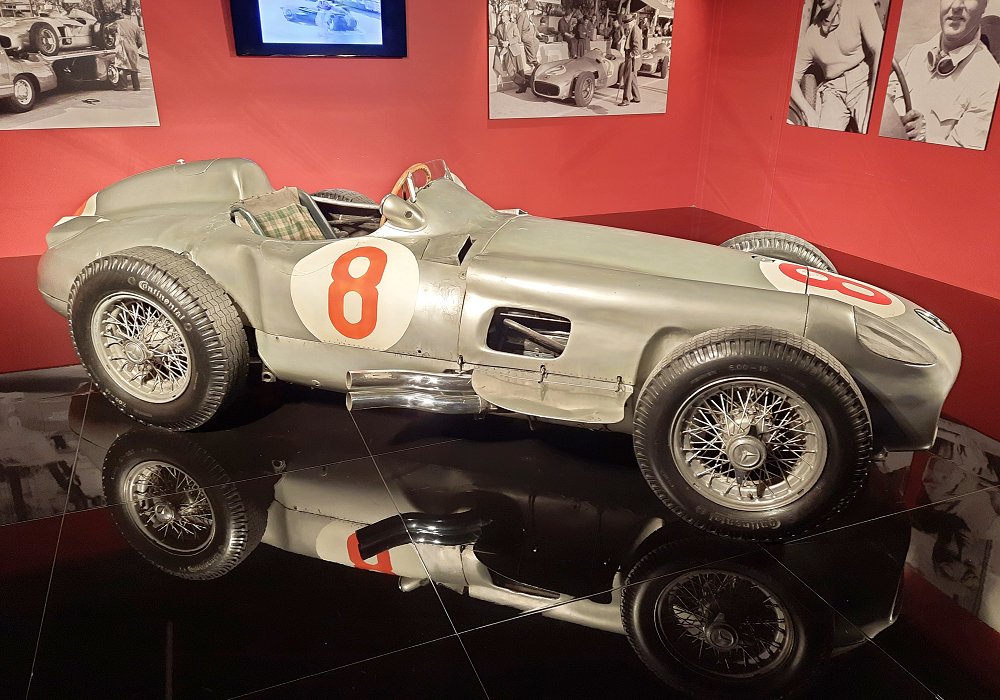
The Mercedes-Benz W196 R Monoposto was the open-wheel version of Mercedes-Benz’s legendary 1950s Grand Prix car and formed the backbone of the brand’s dominance during the early Formula One World Championship era. As part of the famed Silver Arrow lineage, the W196 R Monoposto represented a highly advanced and methodically engineered racing machine, designed to excel on technical circuits where precision, balance and handling were more important than outright top speed.
Introduced in 1954 under the 2.5-litre naturally aspirated Formula One regulations, the W196 R was a radical departure from many of its contemporaries. Power came from a straight-eight engine mounted at an angle to reduce overall height and lower the centre of gravity. The engine featured direct fuel injection derived from Mercedes-Benz aircraft technology, giving it a significant advantage in throttle response, fuel delivery and reliability. Output was approximately 250 horsepower, an exceptional figure for the period, delivered smoothly across a wide rev range.
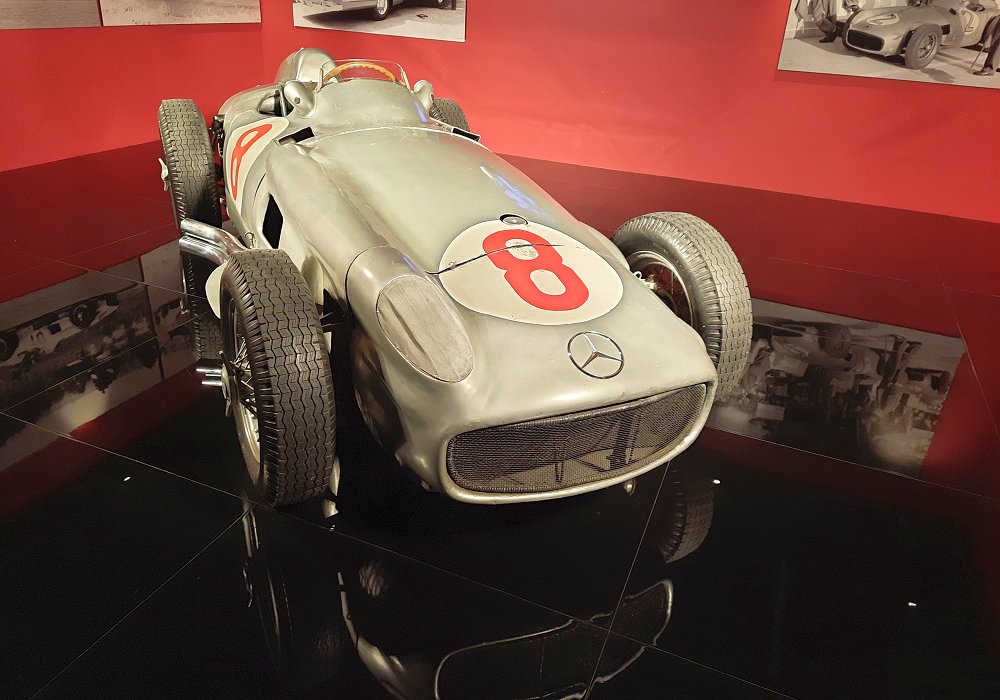
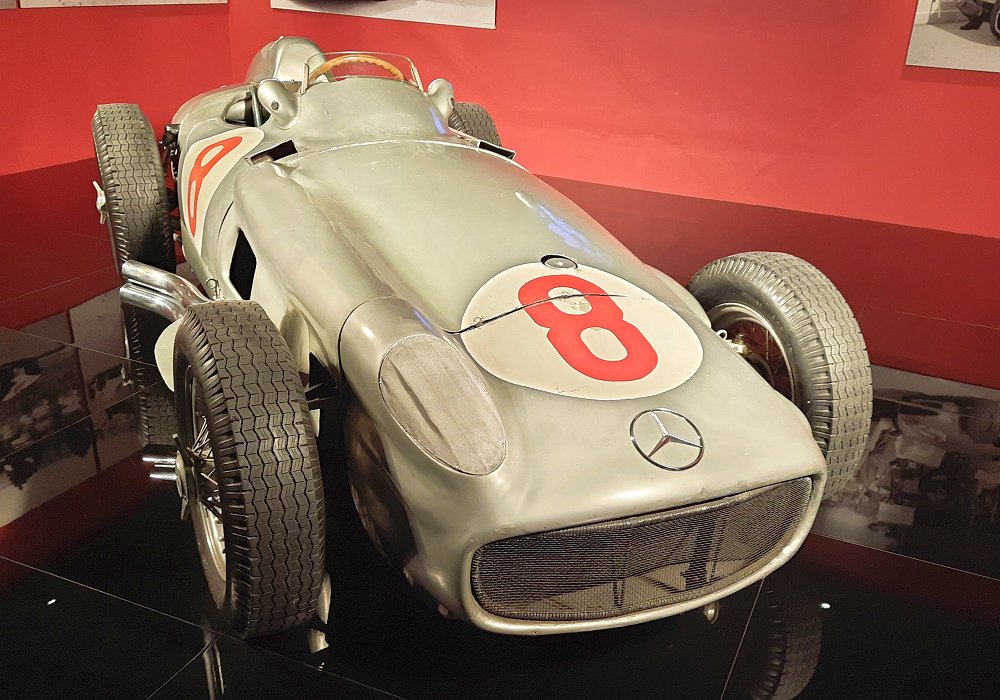
The Monoposto configuration featured exposed wheels and a more conventional open-wheel layout compared with the fully enclosed Stromlinien version. This design offered better visibility, improved wheel placement awareness and superior handling on tight and technical circuits such as Monaco, the Nürburgring and Silverstone. While slightly less aerodynamically efficient than the streamlined body, the Monoposto provided greater confidence and control for drivers, making it the preferred choice for many races.
The chassis was a lightweight tubular spaceframe engineered for strength, rigidity and precision. Independent suspension was used at both the front and rear, providing improved road holding and stability compared with many rival cars of the era. To reduce unsprung weight and improve handling, the rear brakes were mounted inboard rather than at the wheels, an advanced solution that reflected Mercedes-Benz’s attention to detail and willingness to adopt complex engineering solutions for competitive advantage.
Driving the W196 R Monoposto required exceptional skill. Narrow tyres, high speeds and minimal safety measures placed immense demands on the driver, but the car rewarded smooth, disciplined driving. Its predictable handling and mechanical reliability allowed skilled drivers to extract consistent performance over race distances, often outperforming faster but less dependable rivals.
The W196 R Monoposto is inseparably associated with Juan Manuel Fangio, who used the car to secure victories and World Championships in 1954 and 1955. Fangio’s calm, precise driving style was perfectly matched to the Mercedes-Benz philosophy of controlled, efficient racing. Stirling Moss also drove the W196 with great success, further enhancing the car’s legendary status.
On the track, the Monoposto version of the W196 proved devastatingly effective. Mercedes-Benz’s systematic approach to race preparation, combined with the car’s advanced engineering, allowed the team to dominate much of the competition. Reliability was a key strength, with the W196 often finishing races strongly while competitors struggled with mechanical failures.
The Silver Arrow identity was reinforced by the W196 R Monoposto’s unpainted aluminium bodywork, which saved weight and became a symbol of German engineering excellence. The car’s clean, purposeful appearance reflected its design philosophy, where every component served a functional purpose.
Beyond its racing success, the Mercedes-Benz W196 R Monoposto left a lasting legacy in Formula One history. Its use of fuel injection, advanced suspension concepts and disciplined engineering approach influenced the future direction of Grand Prix car design and demonstrated the value of applying scientific principles to motorsport.
Today, the Mercedes-Benz W196 R Monoposto is regarded as one of the greatest Formula One cars ever built. Surviving examples are among the most valuable and revered racing cars in existence. As a historic machine, it stands as a symbol of Mercedes-Benz’s golden era in Grand Prix racing, representing a moment when engineering precision, strategic thinking and driving excellence combined to redefine the limits of motorsport performance.