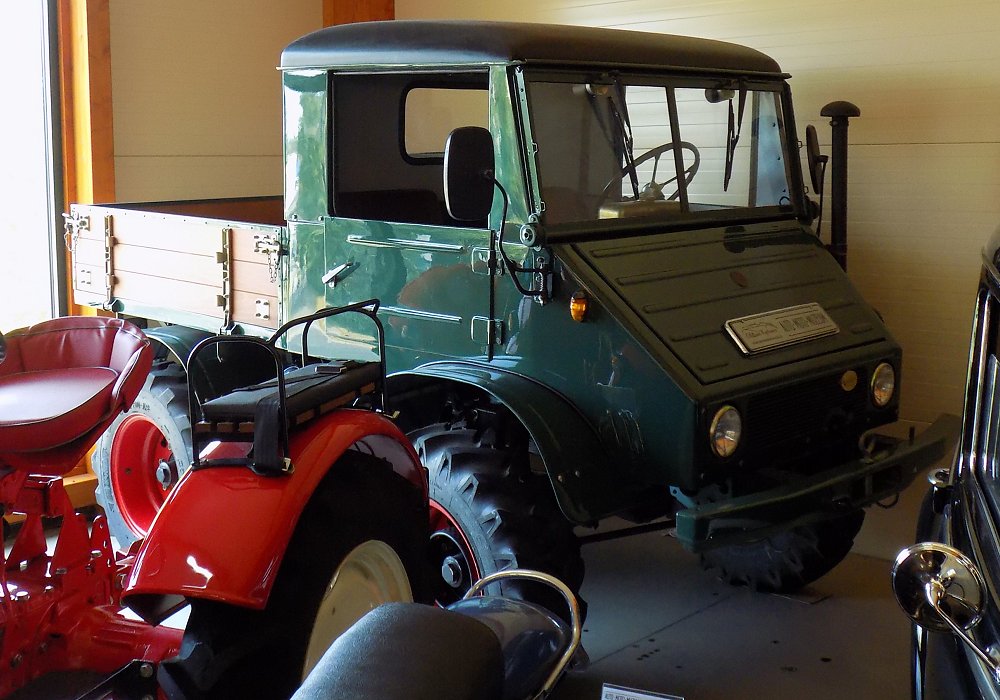
Description
The Mercedes-Benz Unimog 411.30 was a specific and well-known variant within the long-running Unimog 411 series and represented the model in one of its most balanced and widely used forms. Produced during the late 1950s and 1960s, the 411.30 combined compact dimensions, dependable diesel power and exceptional versatility, making it popular across agriculture, forestry, municipal work and industrial applications.
The designation 411.30 identified a particular specification within the 411 range, most notably associated with a diesel engine and a slightly uprated drivetrain compared with earlier petrol-powered variants. Power came from a four-cylinder diesel engine, typically the 1.8-litre unit, producing modest horsepower but strong low-speed torque. This engine was designed for continuous operation under load rather than speed, giving the Unimog 411.30 excellent pulling ability and fuel efficiency. A manual gearbox with multiple forward and reverse ratios allowed precise speed control, including extremely low working speeds essential for agricultural and mechanical tasks.
As with all Unimog models, the 411.30 was defined by its drivetrain and chassis rather than outright performance figures. Portal axles provided high ground clearance while keeping the centre of gravity low, and four-wheel drive ensured traction in mud, snow, sand and steep terrain. Locking differentials were available, further enhancing the vehicle’s ability to keep moving when traction was limited. The ladder-frame chassis was exceptionally strong yet flexible, allowing the vehicle to twist over uneven ground without stressing the structure.
Suspension used coil springs rather than traditional leaf springs, a defining Unimog feature that gave the 411.30 excellent axle articulation. This allowed all four wheels to maintain contact with the ground over rough surfaces, contributing greatly to its legendary off-road capability. Despite its working-vehicle nature, the ride was relatively compliant for its class, especially when operating off road.
The Unimog 411.30 was designed as a true multi-purpose implement carrier. It could be equipped with power take-offs at the front, rear and sometimes mid-mounted positions, enabling the use of a wide range of attachments. These included ploughs, mowers, snow blowers, winches, hydraulic tools and loaders. This flexibility made the 411.30 invaluable to operators who needed a single machine capable of performing many different tasks throughout the year.
Cab options varied depending on production year and market. Early examples often featured open or canvas-covered cabs, while later versions were fitted with enclosed metal cabs offering improved weather protection. The driving position was upright and functional, with excellent visibility and simple, durable controls. Comfort was secondary to usability, but the layout was practical and well suited to long working days.
On the road, the Mercedes-Benz Unimog 411.30 was slow by passenger-car standards, but stable and predictable. Its real strength lay in its ability to transition effortlessly from road travel to fieldwork or off-road operation without modification. This made it particularly attractive to farmers, municipalities and contractors who required maximum versatility from a single vehicle.
The 411.30 earned a reputation for exceptional durability and longevity. Many examples remained in service for decades, often changing roles multiple times during their working lives. The simple, over-engineered diesel drivetrain and robust chassis made maintenance straightforward and allowed the vehicle to operate reliably even in remote areas.
Today, the Mercedes-Benz Unimog 411.30 is regarded as one of the most desirable classic Unimog variants. Valued for its compact size, diesel efficiency and extraordinary adaptability, it remains popular with collectors and working enthusiasts alike. As a classic, the 411.30 stands as a perfect expression of the Unimog philosophy: a machine defined not by speed or luxury, but by capability, versatility and enduring engineering quality.