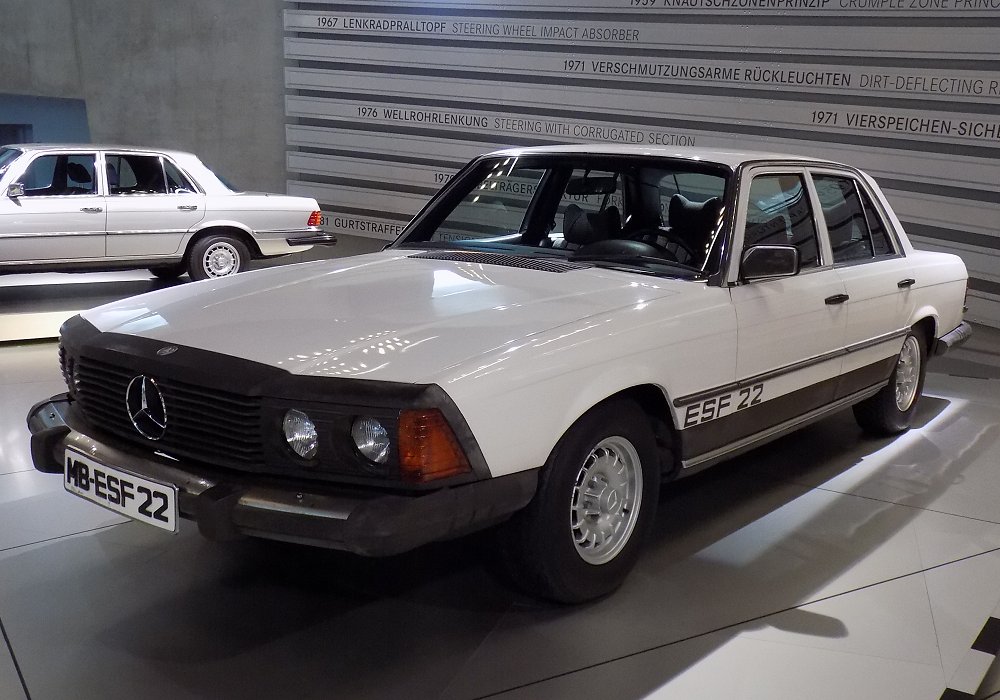
Description
The Mercedes-Benz ESF 22 was an experimental safety vehicle developed in the early 1980s and represented a major milestone in Mercedes-Benz’s long-running ESF programme. Built to demonstrate how emerging safety technologies could be integrated into a realistic production-based car, the ESF 22 showed that advanced occupant protection systems were no longer theoretical concepts, but ready for everyday road use.
The ESF 22 was based on the contemporary Mercedes-Benz S-Class platform of the period, chosen deliberately to reflect a real-world luxury saloon rather than a purely experimental shell. This approach allowed Mercedes-Benz to test safety systems within the constraints of a production body structure, packaging, weight and usability, reinforcing the company’s philosophy that safety innovation should be practical and transferable to series production.
A central focus of the ESF 22 was occupant restraint technology. The vehicle showcased an integrated safety concept combining seat belts, belt tensioners and airbags into a coordinated system. Driver and passenger airbags were key elements, designed to work in harmony with seat belts rather than replace them. This system approach demonstrated improved protection in frontal impacts and helped define the principles that would later become standard in production vehicles.
Body structure and crash energy management were also core areas of development. The ESF 22 featured optimised crumple zones at the front and rear, engineered to absorb impact energy progressively while maintaining the integrity of the passenger cell. Side-impact protection was enhanced through reinforced door structures and energy-absorbing elements, reflecting growing awareness of lateral collision risks.
The ESF 22 also explored advances in braking and vehicle control. Anti-lock braking technology was integrated to maintain steering control during emergency stops, and the vehicle served as a platform for studying how electronic systems could contribute to accident avoidance as well as crash protection. The interaction between chassis dynamics and safety systems was a growing area of interest during this period, and the ESF 22 helped demonstrate the benefits of a holistic approach.
Interior design played a significant role in the ESF 22’s safety concept. The cabin featured carefully shaped surfaces, energy-absorbing materials and redesigned controls intended to reduce injury risk in a collision. Steering wheel design, dashboard structure and seating geometry were all optimised to work together with restraint systems, reinforcing Mercedes-Benz’s belief that passive safety extended far beyond airbags alone.
Although the ESF 22 was never intended for production, many of the technologies it showcased reached showrooms soon afterwards. Airbags, belt tensioners, improved crash structures and electronically assisted braking systems all became defining features of Mercedes-Benz production cars in the late 1980s and 1990s, directly influenced by research carried out under the ESF programme.
The Mercedes-Benz ESF 22 stands today as an important transitional vehicle in automotive safety history. It marked the point where advanced safety systems moved from experimental demonstrations toward widespread real-world application. As part of the ESF lineage, the ESF 22 exemplifies Mercedes-Benz’s long-term commitment to safety engineering, illustrating how careful research, testing and integration can translate into meaningful improvements for everyday road users.