Description
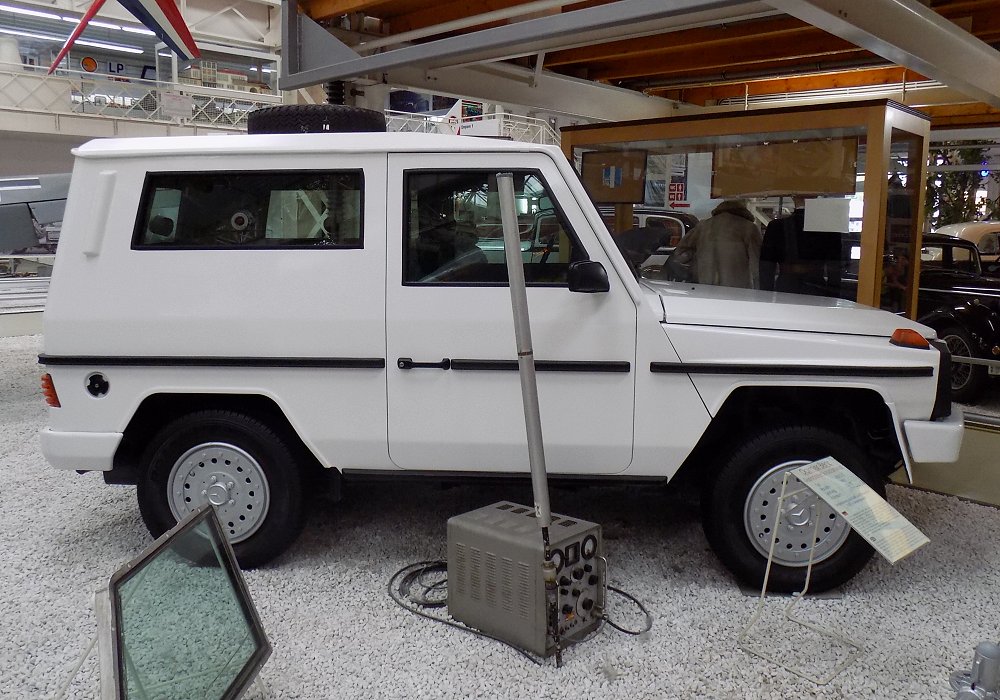
The Mercedes-Benz 460.2 Gepanzert was a specialised armoured variant of the early G-Class and represented one of the most extreme applications of the W460 platform. Developed for military, government and high-risk security roles, the 460.2 Gepanzert combined the uncompromising off-road capability of the G-Class with ballistic protection, creating a vehicle designed to operate in hostile environments where mobility and survivability were equally critical.
The designation “460.2” refers to a specific W460-series configuration adapted for armouring, while “Gepanzert” indicates factory or specialist-applied ballistic protection. Unlike later luxury-armoured Mercedes-Benz models, the 460.2 Gepanzert was conceived as a functional security vehicle rather than a prestige product. Its role was to provide protected transport in unstable regions, conflict zones and sensitive operations, often far from paved roads or support infrastructure.
Powertrains varied depending on contract and operational requirements, but most examples were based on proven G-Class engines known for durability rather than outright performance. These included petrol and diesel units from the standard W460 range, selected for reliability under load and ease of maintenance. The additional weight of armour significantly reduced performance, but this was considered acceptable given the vehicle’s mission profile. A manual transmission with dual-range transfer case was retained, allowing precise low-speed control and continued off-road capability despite the increased mass.
The ladder-frame chassis of the G-Class made it particularly well suited to armouring. Reinforced sections were used to cope with the added weight of ballistic steel and protective glass, while the solid axles front and rear provided strength and load tolerance unmatched by most civilian vehicles of the period. Locking differentials were typically specified, ensuring the vehicle could continue moving even in difficult terrain or when partially disabled.
Ballistic protection focused on small-arms fire and fragmentation threats. Armouring was integrated into the doors, body panels and bulkheads, while thick, multi-layer ballistic glass replaced standard windows. Depending on specification, protection could extend to the engine bay, fuel system and underbody. The level of armour reflected the threats anticipated at the time, prioritising practical protection without rendering the vehicle immobile.
Externally, the Mercedes-Benz 460.2 Gepanzert retained the unmistakable boxy silhouette of the G-Class. Armour was integrated discreetly, and the vehicle often appeared outwardly similar to a standard G-Class apart from thicker window glass, reinforced door frames and sometimes altered ride height. This low-profile appearance was advantageous in security operations, allowing the vehicle to blend in rather than attract attention.
Inside, the cabin was functional and austere. Trim levels were basic, with materials chosen for durability rather than comfort. The presence of armouring reduced interior space and visibility, but the upright driving position and excellent outward view, by armoured-vehicle standards, remained strengths of the G-Class design. Additional communication or security equipment was often fitted depending on the vehicle’s role.
In service, the Mercedes-Benz 460.2 Gepanzert earned a reputation for toughness and reliability. Its ability to combine ballistic protection with true off-road mobility set it apart from many armoured vehicles of the era, which were often limited to paved roads. This made it particularly valuable for military patrols, diplomatic convoys and security operations in remote or unstable regions.
Today, the Mercedes-Benz 460.2 Gepanzert is an extremely rare and historically significant variant of the early G-Class. Surviving examples are scarce, and many were heavily used in service or decommissioned. As a classic, it represents the G-Class in one of its most uncompromising forms, illustrating how Mercedes-Benz engineering could be adapted to meet extreme operational demands. The 460.2 Gepanzert stands as a reminder that long before the G-Class became a luxury icon, it was trusted as a serious tool for protection, mobility and survival.