Description
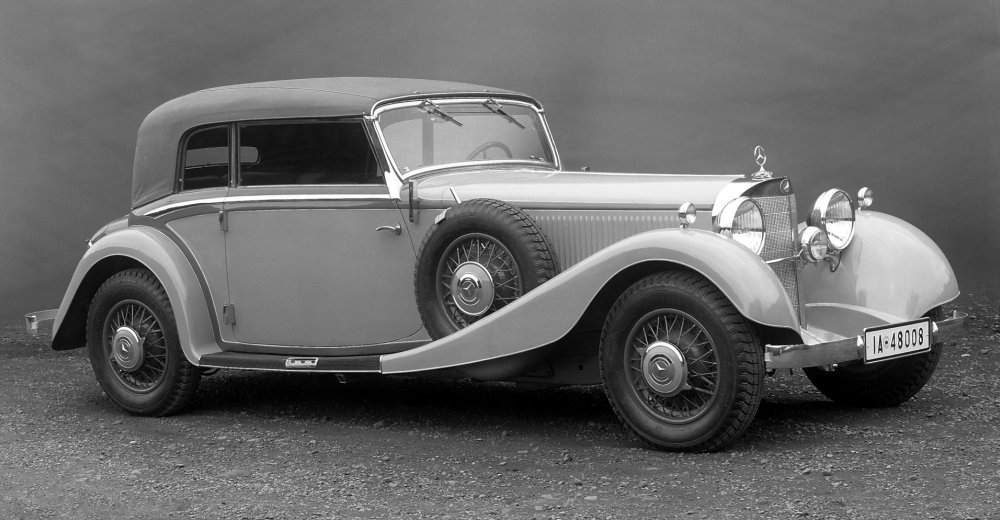
The Mercedes-Benz 380 Cabriolet was one of the most elegant and advanced luxury open cars of the early 1930s, introduced in 1933 as part of Mercedes-Benz’s new generation of large, modern six- and eight-cylinder models. Positioned above the Mannheim series and below the later supercharged prestige cars, the 380 Cabriolet represented a decisive shift away from upright, traditional design toward lower, wider and more streamlined proportions. It combined refined mechanical engineering, advanced chassis design and exquisite Sindelfingen coachwork, making it one of the most important transitional Mercedes-Benz cabriolets of the pre-war era.
Power was provided by a 3.8-litre inline-eight engine producing around 90 horsepower. This smooth and flexible unit marked a significant advance over earlier six-cylinder models, offering superior refinement, quieter operation and stronger mid-range performance. The straight-eight delivered its power in a calm, effortless manner, well suited to the Cabriolet’s role as a long-distance luxury tourer. A four-speed manual gearbox allowed relaxed cruising and confident progress, with gearing chosen to exploit the engine’s smooth torque delivery rather than outright speed.
One of the most important technical features of the Mercedes-Benz 380 was its low-slung chassis. Mercedes-Benz adopted a newly developed frame that allowed the body to sit much lower between the axles, dramatically improving handling, stability and visual proportions. This design lowered the centre of gravity and gave the 380 a more planted and modern driving character than its predecessors. Suspension used semi-elliptic leaf springs front and rear, carefully tuned to balance comfort with control. Hydraulic brakes on all four wheels provided a significant improvement in stopping power and safety, placing the 380 among the most technically advanced luxury cars of its time.
The cabriolet bodywork, produced by the Sindelfingen coachworks, was available in several configurations, including Cabriolet A, B and C, depending on seating and door arrangement. Regardless of variant, the design shared the same graceful proportions: a long bonnet, sweeping integrated wings, a lower beltline and a flowing rear section that housed the folding roof. The roof mechanism was carefully engineered to fold neatly and sit low, preserving the car’s clean lines when open. With the roof raised, the Cabriolet retained an elegant, formal presence; with it lowered, the car became a striking open tourer with a distinctly modern profile.
Inside, the Mercedes-Benz 380 Cabriolet offered a luxurious and carefully finished cabin. Seating was generous and well padded, upholstered in fine leather or high-quality cloth depending on specification. The dashboard featured clear, logically arranged instruments set into polished wood or finely finished metal panels. Switchgear and fittings reflected Mercedes-Benz’s emphasis on precision and durability. The interior environment was quieter and more refined than earlier models, benefiting from improved insulation and the inherent smoothness of the straight-eight engine.
On the road, the 380 Cabriolet delivered a composed and confident driving experience. The straight-eight engine provided effortless acceleration and smooth cruising, while the low chassis and wide track gave the car excellent stability at speed. Steering was deliberate but precise, and the suspension absorbed road imperfections with authority, making long journeys comfortable and unhurried. The Cabriolet was not intended as a sporting machine, but its advanced chassis allowed it to handle with assurance well beyond what its size might suggest.
The Mercedes-Benz 380 Cabriolet played a pivotal role in the evolution of Mercedes luxury cars. It introduced design and engineering principles that would be fully realised in the later 500 K and 540 K models, while remaining more understated and technically focused than those supercharged flagships. Production numbers were limited, and the model had a relatively short lifespan, as it was soon eclipsed by newer and more powerful offerings.
Today, the Mercedes-Benz 380 Cabriolet is regarded as one of the most significant pre-war Mercedes models. It represents the moment when Mercedes-Benz successfully transitioned from traditional upright luxury cars to the low, streamlined grand tourers that defined the late 1930s. Surviving examples are highly prized for their historical importance, elegant proportions and advanced engineering, making the 380 Cabriolet a cornerstone in the story of Mercedes-Benz pre-war design and luxury motoring.