Description
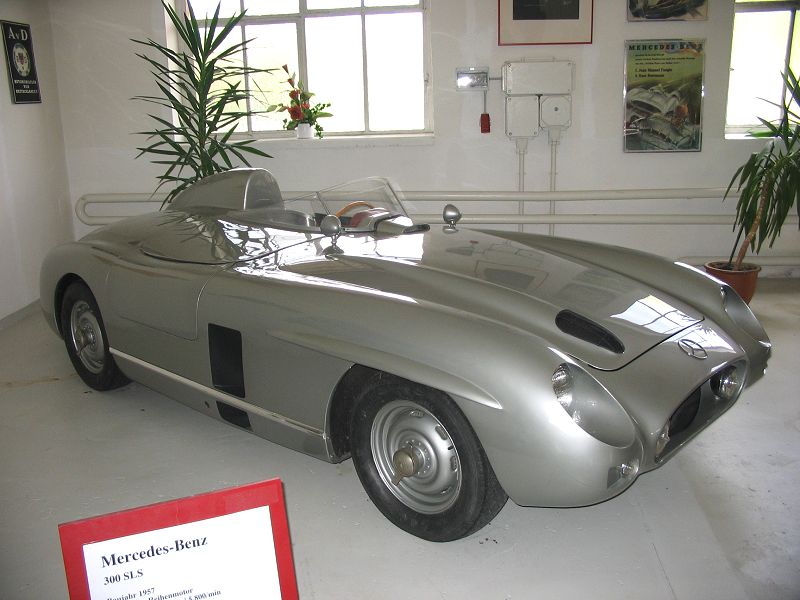
The Mercedes-Benz 300 SLS was a rare and highly specialised competition sports car developed in the late 1950s as a bridge between the legendary 300 SLR racing programme and the production-based 300 SL Roadster. Built in extremely small numbers, the 300 SLS was created specifically for motorsport use, most notably for competition in the United States, and was never intended as a road-going production model.
Power came from a modified version of the 3.0-litre inline six-cylinder engine used in the 300 SL, retaining mechanical direct fuel injection but tuned for racing. Output was increased to around 235 horsepower, giving the car stronger acceleration and improved high-speed performance compared with the standard roadster. The engine emphasised reliability and sustained performance rather than peak output, reflecting the demands of long-distance racing. Power was transmitted through a manual gearbox geared for competition use.
The 300 SLS was based on the 300 SL Roadster chassis but featured significant weight reduction and race-specific modifications. Body panels were made thinner, interior trim was largely removed, and equipment was stripped back to the essentials. The result was a lighter and more focused car that retained the fundamental engineering strengths of the 300 SL while being better suited to circuit racing.
Suspension was revised for competition, with stiffer settings and improved geometry to enhance stability and handling at speed. Compared with the earlier 300 SL Coupé, the roadster-based layout offered more predictable handling characteristics, making the 300 SLS easier to control at the limit. Braking systems were uprated to cope with sustained high-speed use, providing greater confidence during long races.
Styling of the Mercedes-Benz 300 SLS was functional and understated. Externally, it closely resembled the 300 SL Roadster but with subtle differences such as a lower windscreen, simplified exterior detailing and competition equipment. The appearance was purposeful rather than dramatic, reflecting its role as a privateer-friendly racing machine rather than a factory showpiece.
Inside, the cockpit was stripped and utilitarian. Comfort was irrelevant, with lightweight seats, minimal instrumentation and no unnecessary trim. Everything was arranged to reduce weight and improve driver focus, reinforcing the car’s purely competitive intent.
The 300 SLS is best remembered for its success in American sports car racing, particularly in SCCA events, where it proved highly competitive against contemporary rivals. Its combination of strong performance, improved handling and Mercedes-Benz reliability made it an effective and respected racing car, even though it lacked the outright spectacle of the earlier V8-powered SLR.
Only two examples of the Mercedes-Benz 300 SLS are believed to have been built, making it one of the rarest vehicles ever produced by Mercedes-Benz. Its existence highlights the company’s continued involvement in motorsport after its official withdrawal from international racing and demonstrates how racing development continued quietly through specialised projects.
Today, the Mercedes-Benz 300 SLS is regarded as an obscure but highly significant chapter in Mercedes-Benz history. Valued for its rarity, competition pedigree and direct connection to the 300 SL and SLR lineage, it represents the final evolution of Mercedes-Benz’s front-engined racing sports cars of the 1950s. As a historical racing machine, the 300 SLS occupies a unique place between legendary factory racers and iconic road-going sports cars.