Description
The Mercedes-Benz 300 SLR Roadster was one of the most advanced and formidable racing sports cars of the 1950s and stands as a landmark in motorsport history. Developed directly from Mercedes-Benz’s post-war racing programme, the 300 SLR was conceived purely for competition and represented the ultimate evolution of the company’s front-engined endurance racing cars. Although sometimes associated by name with the 300 SL, the SLR was a very different machine, engineered without compromise for speed, durability and control in the world’s most demanding races.
Power came from a 3.0-litre inline eight-cylinder engine derived from Mercedes-Benz Grand Prix technology. Unlike the six-cylinder unit used in the 300 SL, this engine featured desmodromic valve actuation and was mounted at an angle to reduce bonnet height and improve weight distribution. Producing around 300 horsepower, the engine delivered extraordinary performance for its time, allowing the lightweight roadster to reach extremely high speeds while maintaining mechanical reliability over long distances. Power was transmitted through a five-speed manual gearbox designed to cope with both high-speed sections and tight circuits.
The chassis was based on an ultra-lightweight tubular spaceframe, similar in concept to the 300 SL but further refined for racing use. Extensive use of lightweight materials, including magnesium alloy body panels known as Elektron, resulted in an exceptionally low overall weight. This gave the 300 SLR a remarkable power-to-weight ratio and allowed it to dominate endurance events through both speed and efficiency.
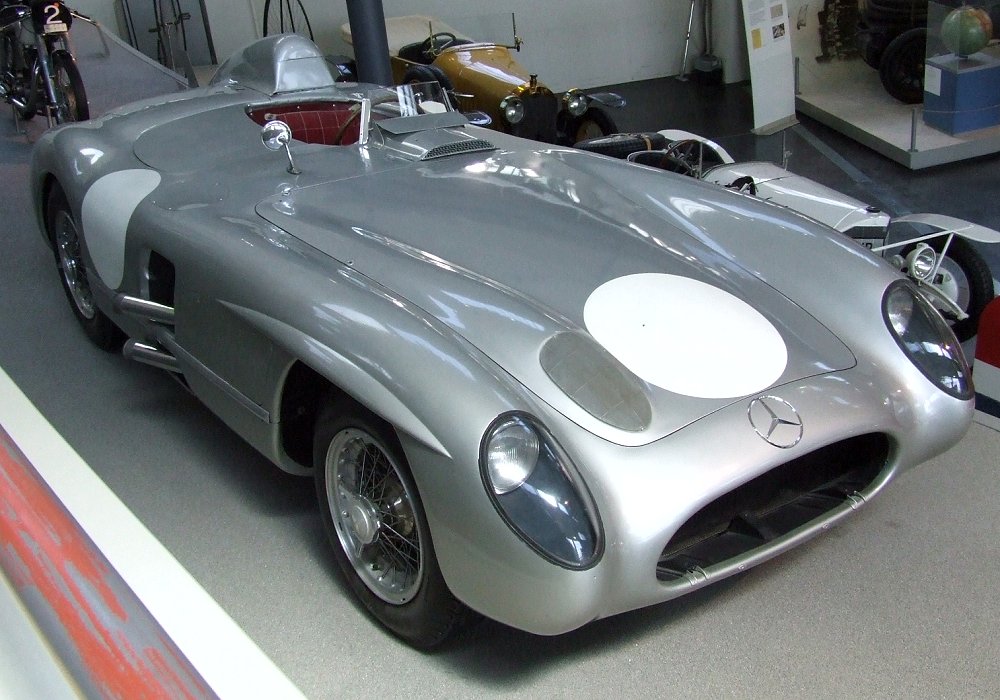
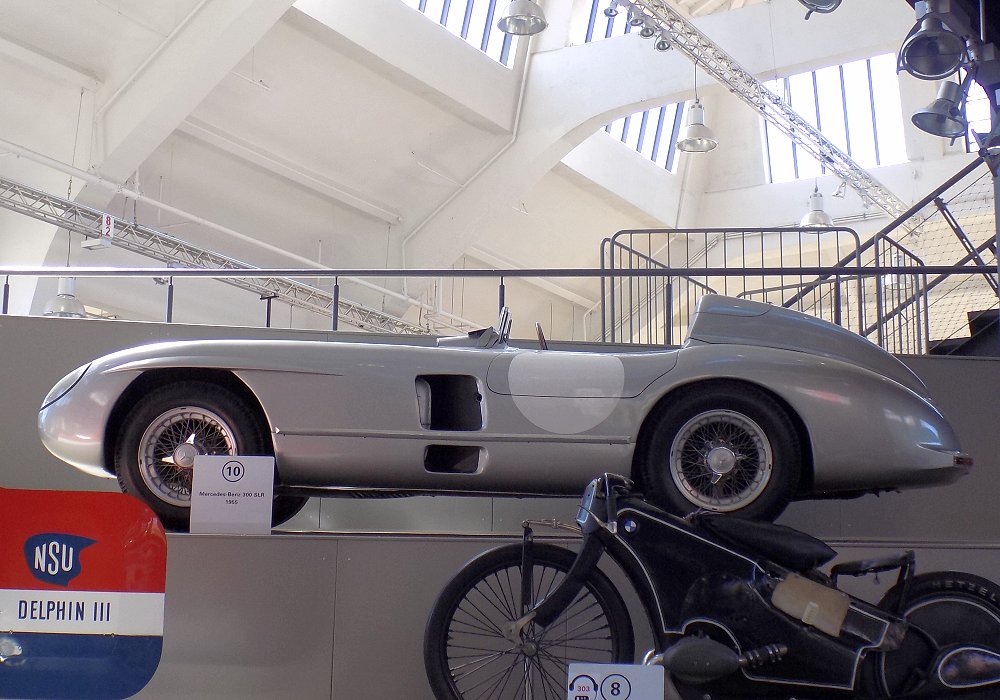
Suspension was carefully tuned for high-speed stability and precise control. Double wishbones were used at the front, while a low-pivot swing axle was fitted at the rear to improve handling characteristics compared with earlier designs. Braking was equally innovative, featuring large inboard drum brakes to reduce unsprung weight, supplemented by a dramatic air brake mounted at the rear. This hinged panel deployed under braking to increase aerodynamic drag and stability, particularly during high-speed deceleration.
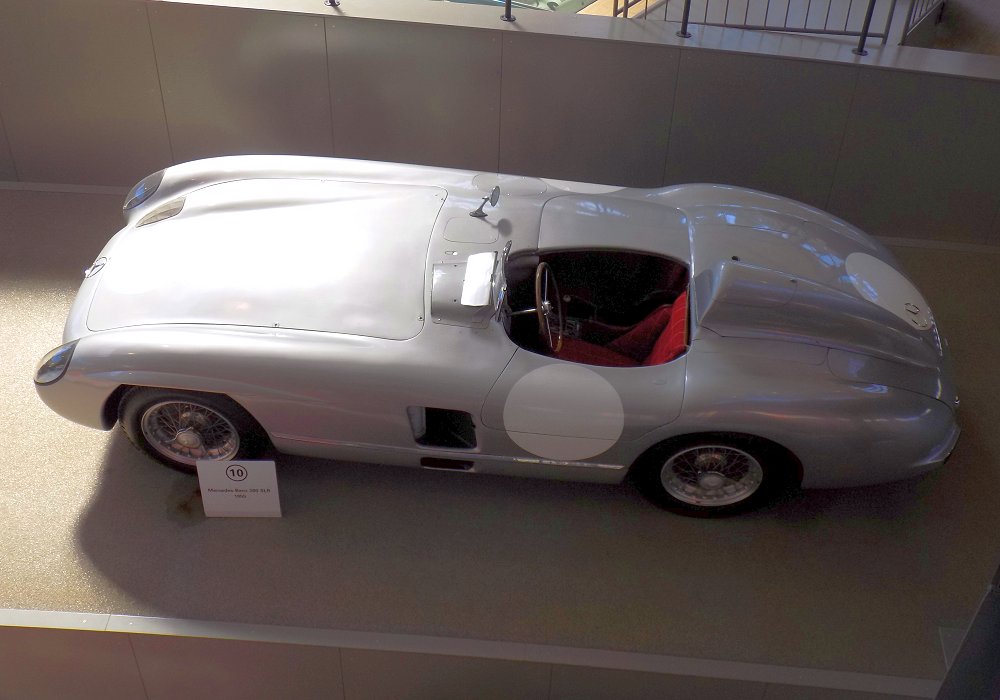
Styling of the Mercedes-Benz 300 SLR Roadster was entirely functional. The long, narrow body was shaped to minimise aerodynamic drag, with exposed wheels, a low windscreen and a tapered tail. The design prioritised airflow, cooling and accessibility over aesthetics, resulting in a purposeful and aggressive appearance that clearly communicated its racing intent. The open cockpit reflected the norms of the era, offering minimal protection but excellent visibility.
Inside, the cockpit was stripped to the essentials. Lightweight bucket seats, basic instrumentation and simple controls defined the interior. Comfort was irrelevant, as the car was built solely for competition. Every component was designed to reduce weight, improve reliability and allow drivers to maintain focus during long and physically demanding races.
On the track and road circuits, the Mercedes-Benz 300 SLR Roadster proved to be devastatingly effective. It achieved legendary success in events such as the Mille Miglia, where it delivered one of the most famous victories in motorsport history, and played a central role in Mercedes-Benz’s dominance of the 1955 World Sportscar Championship. The car’s speed, reliability and advanced engineering placed it well ahead of most competitors.
Despite its success, the career of the 300 SLR was short-lived. Following the tragic accident at Le Mans in 1955, Mercedes-Benz withdrew from international motorsport, bringing the era of the SLR to an abrupt end. Only a small number of 300 SLR Roadsters were built, and none were intended for public sale.
Today, the Mercedes-Benz 300 SLR Roadster is regarded as one of the greatest racing cars ever created. Valued for its extraordinary engineering, historic victories and rarity, it represents the peak of front-engined sports car development. As a symbol of Mercedes-Benz’s technical brilliance and racing ambition, the 300 SLR Roadster occupies a unique and revered place in automotive history.