Description
The Mercedes-Benz 300 SE Rallye was a competition-oriented adaptation of the W112 flagship saloon, developed to demonstrate that Mercedes-Benz luxury engineering could be successfully applied to the demanding world of long-distance rallying. Emerging in the early 1960s, it stood apart from lighter, more overtly sporting rivals by relying on strength, reliability and advanced technology rather than minimal weight or extreme tuning.
At its core was the 3.0-litre inline six-cylinder petrol engine with mechanical fuel injection, producing around 160 horsepower in standard form. For rally use, the emphasis was not on increasing peak output but on ensuring durability, consistent torque delivery and dependable operation under sustained stress. The fuel-injected engine proved well suited to endurance competition, offering strong mid-range performance, reliable cold starting and stable running over long distances and varying conditions.
Power was typically delivered through a reinforced manual gearbox, chosen for driver control and robustness. The drivetrain was engineered to withstand prolonged high-speed running and rough surfaces, reflecting Mercedes-Benz’s conservative but highly effective approach to motorsport during this period.
One of the most distinctive technical features carried over from the road-going 300 SE was its air suspension system. While unconventional for rallying, it provided excellent ride comfort and stability over uneven terrain and could maintain consistent ride height despite heavy loads of fuel, equipment and spare parts. For competition use, the system was strengthened and carefully tuned to cope with harsher conditions, contributing to the car’s surprising effectiveness on rough roads.
The W112 unitary body structure was inherently strong, and rally versions were further reinforced to improve rigidity and safety. Suspension components were uprated, and braking systems were improved to cope with sustained high-speed use. Unlike many rally cars of the era, the 300 SE Rallye retained much of its original bodywork, reinforcing the impression of a dignified executive saloon transformed into a serious competition machine.
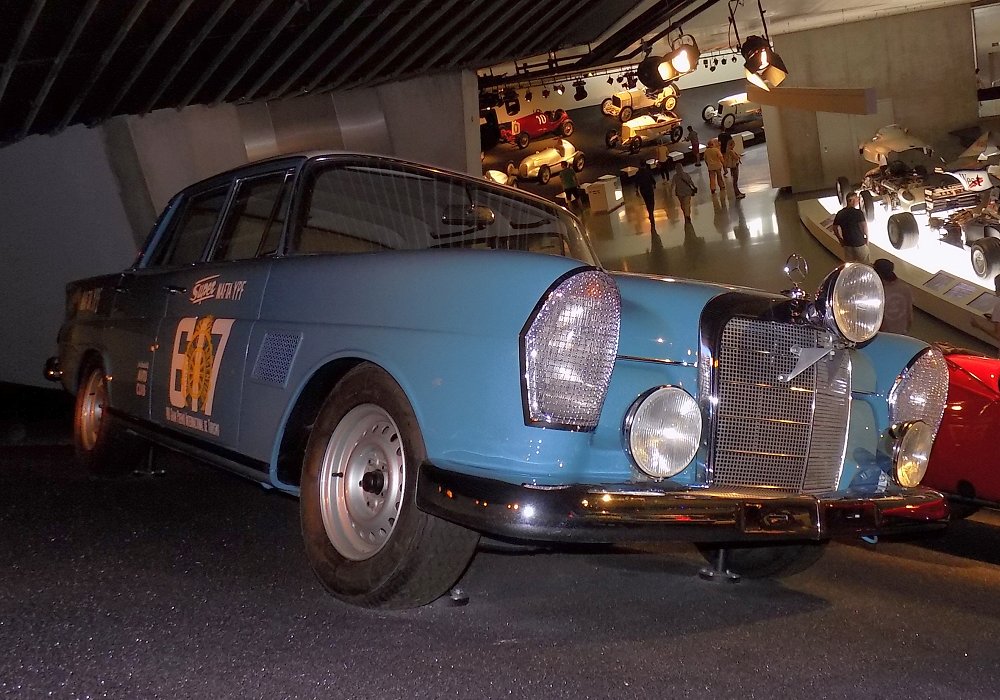
Externally, changes were functional rather than dramatic. Additional driving lights were fitted for night stages, along with reinforced bumpers, protective underbody panels and rally-specific wheels and tyres. The car’s formal fintail styling remained largely intact, creating a striking contrast between its elegant appearance and its rugged rally role.
Inside, the cabin was adapted for competition with stripped trim, reinforced seating, safety equipment and navigation tools for the co-driver. Despite these changes, the interior still reflected Mercedes-Benz’s emphasis on solid construction and logical layout, even in a motorsport context.
In competition, the Mercedes-Benz 300 SE Rallye proved particularly effective in long, demanding events where reliability and consistency were more important than outright speed. It achieved notable success in European and international rallies, helping to re-establish Mercedes-Benz’s motorsport credibility after a period of reduced factory involvement. These efforts laid important groundwork for later and more famous rally programmes.
Today, the Mercedes-Benz 300 SE Rallye is remembered as a fascinating example of an unconventional but highly effective rally car. It demonstrated that advanced engineering, durability and comfort-focused design could be successfully adapted to motorsport. As a result, it occupies a unique place in Mercedes-Benz history, bridging the worlds of luxury saloons and endurance rally competition in a way few other cars have achieved.