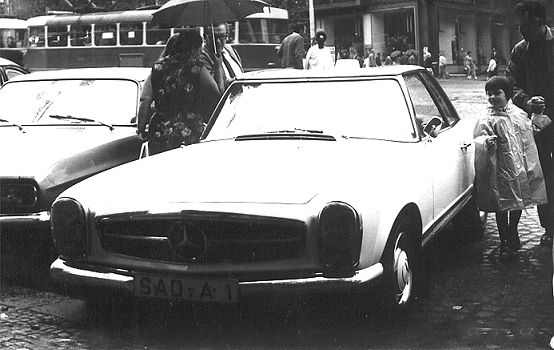
Description
The Mercedes-Benz 250 SL was the transitional model of the W113 “Pagoda” series and occupied a unique position between the early 230 SL and the later, more powerful 280 SL. Introduced in the mid-1960s, it combined the elegant design and safety-focused engineering of the W113 platform with improved mechanical sophistication, making it one of the most balanced and subtly capable SL models of its era.
Power came from a 2.5-litre inline six-cylinder petrol engine with mechanical fuel injection, producing approximately 150 horsepower. While peak power output was similar to the earlier 230 SL, the larger displacement delivered improved torque and smoother mid-range response. This made the 250 SL more flexible and relaxed in everyday driving, particularly at higher cruising speeds. Buyers could choose between a four-speed manual gearbox, a four-speed automatic transmission or the desirable ZF five-speed manual, allowing the car to be tailored to either touring comfort or more involved driving.
The chassis was based on the W111 saloon platform and reflected Mercedes-Benz’s increasing emphasis on safety and structural integrity. The rigid body incorporated crumple zones and a reinforced passenger cell, setting standards that were advanced for a sports roadster of the period. Suspension consisted of double wishbones at the front and a low-pivot swing-axle rear suspension, providing predictable handling and a comfortable ride when driven in the car’s intended grand touring role. Braking was improved over earlier models, with front disc brakes and rear discs fitted on the 250 SL, a notable technical upgrade within the W113 range.
Styling of the Mercedes-Benz 250 SL followed the clean, timeless design introduced by the 230 SL. The gently concave removable hardtop, which gave rise to the “Pagoda” nickname, remained a defining feature and combined visual elegance with structural strength and excellent visibility. The car could be driven with a soft top, hardtop or fully open, offering genuine versatility and year-round usability. Subtle exterior detailing and balanced proportions gave the 250 SL a refined presence rather than a sporting or aggressive look.
Inside, the cabin reflected Mercedes-Benz’s focus on ergonomics, safety and durability. The padded dashboard, recessed switches and clear instrumentation were designed to reduce injury risk while maintaining excellent usability. Seats were comfortable and supportive, suitable for long-distance touring, and interior materials were chosen for longevity and quality rather than ornamentation. Compared with earlier SL models, the overall environment felt calm, solid and reassuring.
On the road, the Mercedes-Benz 250 SL delivered a composed and confidence-inspiring driving experience. The revised engine offered smoother power delivery, while the upgraded braking system improved confidence during sustained driving. Steering was light and precise, and the suspension absorbed poor road surfaces effectively. The car was never intended to be a pure sports car, but it excelled as a refined open tourer capable of relaxed long-distance travel.
The 250 SL appealed to buyers who wanted the elegance and prestige of the SL line with subtle mechanical improvements and modernised driving manners. Produced for a relatively short period, it was offered in smaller numbers than both the 230 SL and 280 SL, contributing to its understated reputation.
Today, the Mercedes-Benz 250 SL is regarded as a connoisseur’s choice within the W113 family. Valued for its disc brakes, smooth engine characteristics and classic Pagoda design, it represents an important evolutionary step in the SL story. As a classic, it offers a rare combination of refinement, usability and historical significance, embodying Mercedes-Benz’s approach to understated luxury roadsters in the 1960s.