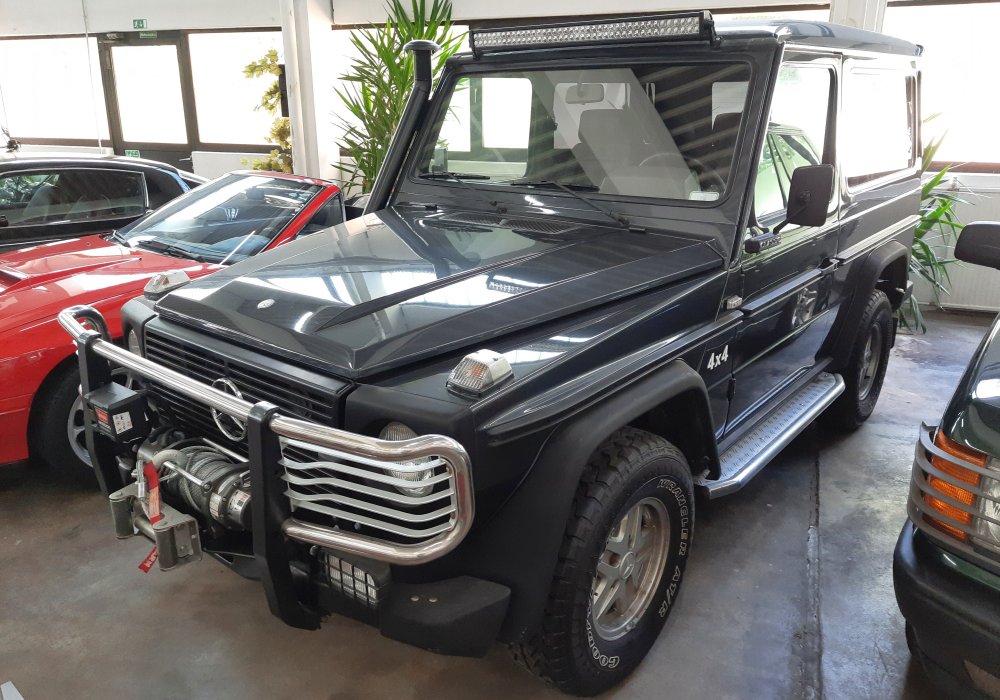
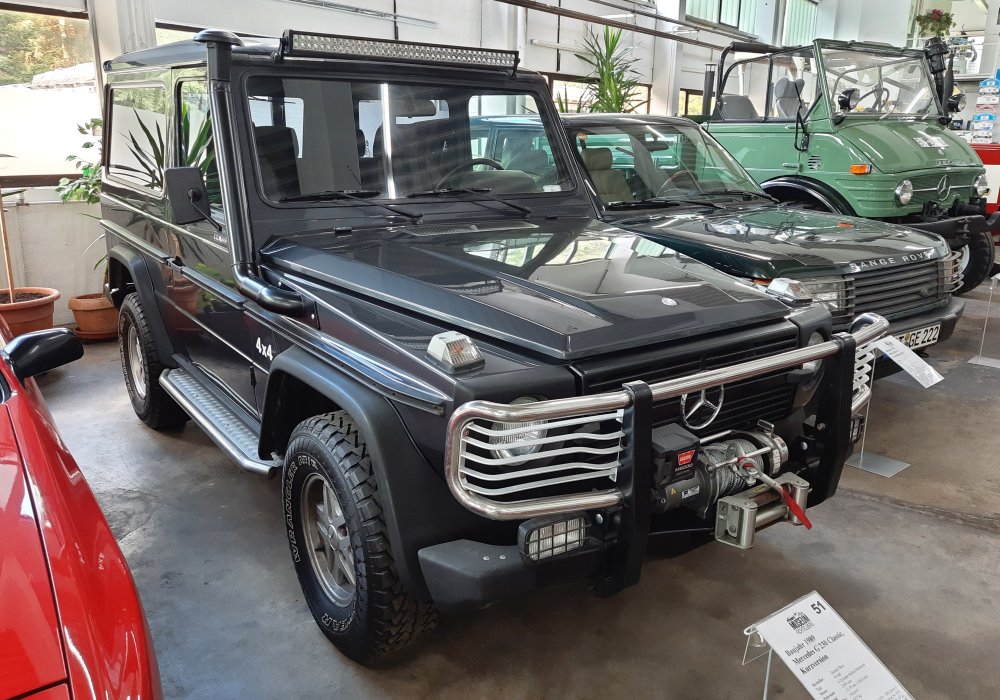
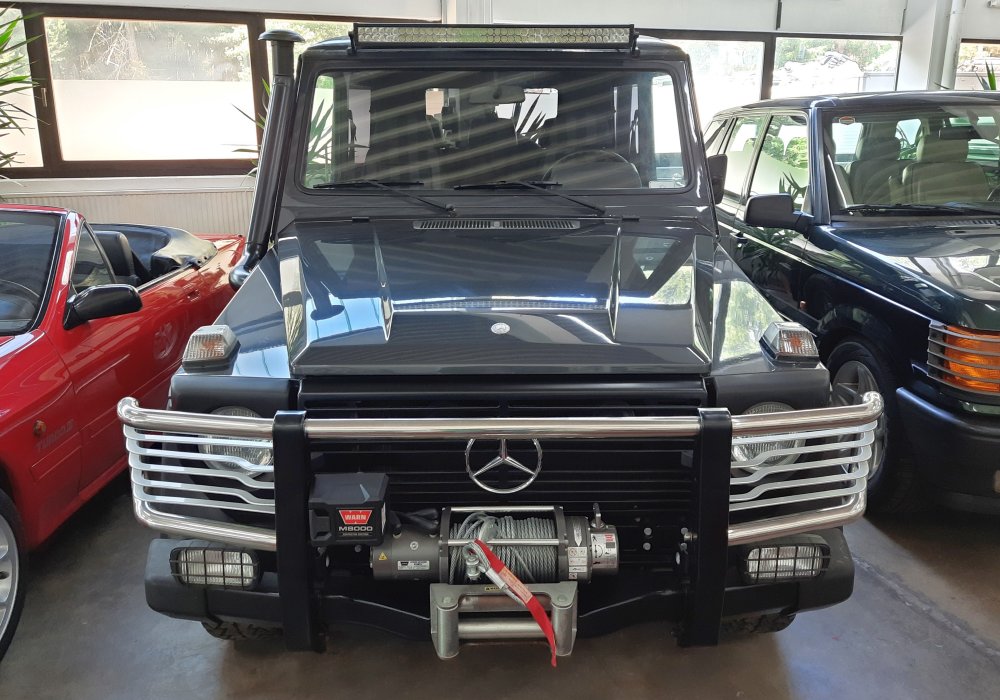
Description
The Mercedes-Benz 230 GE Kurz was the short-wheelbase version of the early civilian G-Class and represented one of the purest expressions of the model’s original design philosophy. Built on the W460 platform, the 230 GE Kurz combined compact dimensions, mechanical simplicity and genuine off-road capability, making it especially well suited to demanding terrain and utilitarian roles.
Power came from a 2.3-litre inline four-cylinder petrol engine equipped with fuel injection, producing around 125 horsepower. Compared with the earlier carburetted 230 G, the GE offered smoother throttle response, improved reliability and better drivability across a wider range of conditions. The engine was not designed for outright speed but delivered steady, predictable torque that worked well both on and off road. A four-speed manual gearbox was standard, paired with a dual-range transfer case that allowed low-range gearing for steep climbs, rough ground and slow-speed control.
The defining feature of the 230 GE Kurz was its short wheelbase. This gave the vehicle excellent approach and departure angles, making it particularly capable in tight off-road situations such as rocky trails, forest tracks and steep inclines. The ladder-frame chassis and solid axles at both ends provided exceptional strength and articulation, while available locking differentials greatly enhanced traction on slippery or uneven surfaces. Suspension was tuned for durability and load-bearing rather than comfort, reinforcing the vehicle’s working character.
Braking and steering were robust and functional, suited to the vehicle’s role rather than refined road manners. On the road, the 230 GE Kurz felt firm, upright and deliberate, with limited high-speed comfort but a strong sense of mechanical integrity. Off road, it excelled, offering confidence and capability in conditions that would defeat most conventional vehicles.
Styling of the Mercedes-Benz 230 GE Kurz was entirely functional. Flat body panels, upright glass and sharp edges were chosen for ease of manufacture, visibility and repair rather than aesthetics. This uncompromising design gave the G-Class its instantly recognisable silhouette, one that would remain largely unchanged for decades. Body styles included hardtop and soft-top configurations, allowing the Kurz to be adapted for military, agricultural, industrial or recreational use.
Inside, the cabin was sparse and purposeful. Materials were selected for durability, controls were simple and clearly laid out, and the driving position was upright with excellent visibility in all directions. Comfort features were minimal, especially in early examples, reflecting the vehicle’s role as a tool rather than a luxury product.
The 230 GE Kurz was widely used by military forces, emergency services, forestry operators and private owners who needed a compact but extremely capable off-road vehicle. Its shorter wheelbase made it particularly attractive for work in confined or difficult terrain, while its mechanical simplicity ensured long service life even in remote areas.
Today, the Mercedes-Benz 230 GE Kurz is regarded as a highly desirable classic among enthusiasts of early G-Class models. Valued for its compact proportions, fuel-injected engine and uncompromising off-road ability, it represents the G-Class in its most honest and utilitarian form. As a classic, the 230 GE Kurz stands as a reminder of a time when the G-Class was defined entirely by function, durability and real-world capability rather than luxury or status.