
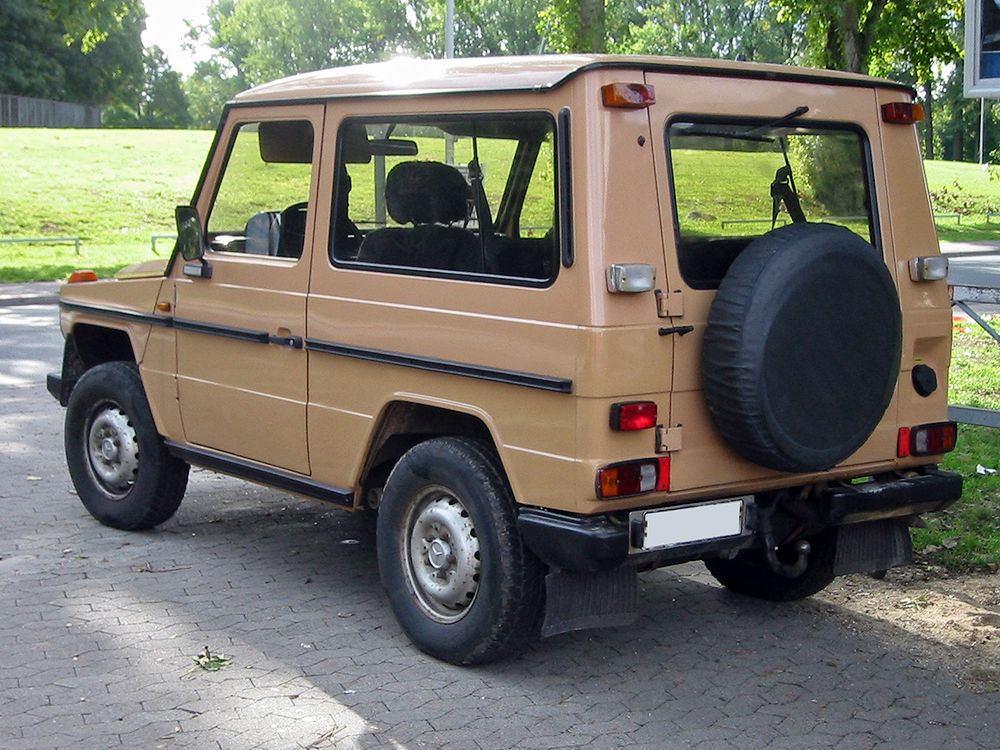
Description
The Mercedes-Benz 230 G was one of the earliest civilian versions of the G-Class and played a crucial role in establishing the model’s reputation for durability, versatility and no-nonsense engineering. Introduced in the late 1970s as part of the original W460 series, the 230 G was designed as a true off-road vehicle first and foremost, with comfort and luxury very much secondary to strength and reliability.
Power came from a 2.3-litre four-cylinder petrol engine producing around 90 horsepower. While modest by modern standards, the engine was valued for its robustness, simplicity and ability to operate reliably in harsh conditions. Power delivery was smooth and predictable, well suited to low-speed off-road driving rather than high-speed road use. A four-speed manual gearbox was standard, paired with a dual-range transfer case that allowed the driver to select low-range gearing for difficult terrain.
The defining feature of the 230 G was its chassis. It used a ladder-frame construction with solid axles front and rear, providing exceptional strength and articulation off road. Locking differentials were available, significantly improving traction in mud, sand and rocky conditions. Suspension was designed for durability and load-carrying ability rather than ride comfort, giving the 230 G its famously tough and purposeful driving character.
Braking was simple and robust, appropriate for the vehicle’s working role, and steering was heavy at low speeds but precise and dependable. On the road, the 230 G felt utilitarian and deliberate, with limited outright performance but a strong sense of mechanical honesty. Off road, however, it excelled, capable of traversing terrain that would defeat most contemporary vehicles.
Styling of the Mercedes-Benz 230 G was purely functional. The boxy bodywork, flat panels and upright glass were designed for ease of manufacture, visibility and repair rather than aesthetics. This uncompromising design gave the G-Class its instantly recognisable silhouette, which would change very little over the decades. Body styles included short- and long-wheelbase versions, with options such as soft tops, station wagons and utility configurations.
Inside, the cabin was sparse and practical. Materials were chosen for durability rather than comfort, with simple seats, minimal trim and straightforward instrumentation. The driving position was upright with excellent visibility, ideal for off-road use and working environments. While basic, the interior reflected the vehicle’s purpose as a tool rather than a luxury product.
The 230 G was used widely by military forces, emergency services, agricultural users and private owners who needed a vehicle capable of operating in extreme conditions. Its mechanical simplicity and rugged construction made it particularly attractive in remote areas where reliability and ease of maintenance were critical.
Today, the Mercedes-Benz 230 G is regarded as one of the purest expressions of the original G-Class concept. Valued for its honesty, toughness and mechanical integrity, it represents a time before the G-Class evolved into a luxury icon. As a classic, the 230 G stands as a reminder of Mercedes-Benz’s ability to engineer vehicles that prioritise function, durability and real-world capability above all else.