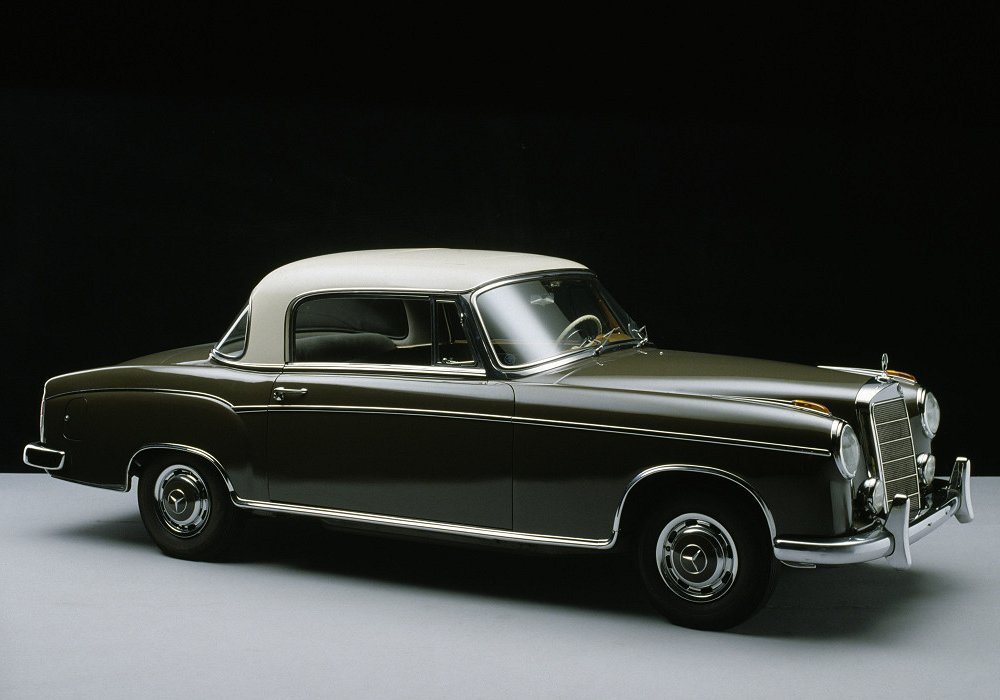
Description
The Mercedes-Benz 220 S Coupé was one of the most elegant and refined expressions of the Ponton era, combining six-cylinder performance with bespoke two-door coachwork and traditional Mercedes-Benz craftsmanship. Introduced in 1956 as part of the W180 series, the 220 S Coupé sat above the saloon in both price and exclusivity and was aimed at buyers seeking a prestigious personal car rather than a family or chauffeur-driven vehicle. It represented a continuation of Mercedes-Benz’s long tradition of hand-finished coupés, even as the company moved steadily toward more standardised production.
Power came from the 2.2-litre inline six-cylinder petrol engine fitted with twin carburettors, producing approximately 106 horsepower. This engine gave the 220 S Coupé strong performance for its time, with smooth acceleration and relaxed high-speed cruising. The six-cylinder layout delivered excellent refinement, making the car especially well suited to long-distance touring. A four-speed manual gearbox drove the rear wheels, and the drivetrain was tuned to emphasise smoothness and mechanical longevity rather than sporting aggression.
The car used the Ponton unitary body construction, but the coupé body was unique to this model and shared little with the four-door saloon beyond basic structure. The roofline was lower and more flowing, the doors were longer, and the side windows were frameless, giving the car a far more elegant and sporting profile. The proportions were carefully balanced, with a long bonnet, compact rear section and restrained chrome detailing. Unlike the saloon, the coupé conveyed exclusivity through subtlety rather than size or ornamentation.
Suspension and running gear followed the 220 S saloon, with independent front suspension using double wishbones and coil springs, and a rear swing axle with coil springs. This setup provided a comfortable and stable ride, particularly at cruising speeds. Hydraulic drum brakes were fitted on all four wheels and were adequate for the car’s performance, though driving the coupé rewarded smooth, anticipatory inputs rather than aggressive braking or cornering.
Inside, the Mercedes-Benz 220 S Coupé offered a noticeably more luxurious and intimate cabin than the saloon. Seating was typically upholstered in fine leather or high-quality cloth, with greater attention paid to detail and finish. The dashboard was clean and elegant, with clear instrumentation and high-grade materials. Front seats were generously proportioned and designed for long-distance comfort, while rear seating was suitable for occasional adult use. Sound insulation was improved, reinforcing the car’s character as a refined grand touring machine.
On the road, the 220 S Coupé delivered calm, assured performance. The six-cylinder engine provided effortless cruising, and the car felt most at home on open roads rather than in urban traffic. Steering was accurate but relatively heavy at low speeds, and the swing-axle rear suspension required smooth driving to maintain composure. The overall experience was one of dignity and composure rather than sportiness, aligning with Mercedes-Benz’s philosophy of the period.
Production of the Mercedes-Benz 220 S Coupé was limited, as each car required extensive hand assembly and finishing. Its high price placed it firmly in the luxury segment, and buyers were typically professionals, industrialists or enthusiasts who valued craftsmanship and understated prestige. As a result, the coupé was far rarer than the saloon and even rarer today.
Today, the Mercedes-Benz 220 S Coupé is regarded as one of the most desirable Ponton-era Mercedes-Benz models. Surviving examples are highly valued for their elegance, build quality and historical significance. It stands as a bridge between pre-war coachbuilt luxury cars and the more modern coupés that would follow in the late 1950s and 1960s, capturing a moment when Mercedes-Benz combined modern engineering with traditional craftsmanship in a uniquely refined form.