Description
The McLaren M1A Oldsmobile was the very first racing car designed and built by Bruce McLaren’s newly formed company, McLaren Motor Racing, in 1964. It marked the beginning of the McLaren marque as a constructor and laid the foundation for the entire line of McLaren sports racing cars that would soon dominate the Can-Am series. The M1A combined lightweight construction, clean aerodynamic design and the raw power of an American V8, creating a car that was both competitive and immediately influential.
Power came from a 4.5-litre Oldsmobile V8, chosen for its simplicity, compactness and strong tuning potential. In racing trim the engine produced around 310 to 350 horsepower, depending on specification. The Oldsmobile unit was lighter than many contemporary big-block engines, and when installed in the lightweight M1A chassis it produced strong acceleration and a characteristically broad torque curve. Its mechanical straightforwardness made it easy to service and reliable under race conditions, an advantage for the small and resource-limited McLaren team.
The chassis of the M1A was built around a tubular spaceframe constructed from lightweight but robust mild steel. Bruce McLaren and engineer Robin Herd focused on weight reduction, rigidity and simplicity. The chassis carried aluminium body panels shaped for good airflow while keeping the structure easy to manufacture and repair. Suspension was independent at all four corners, using unequal-length wishbones and coil-spring dampers, giving the M1A sharp handling for its era and making it well suited to the fast, undulating circuits common in North American sports-car racing.
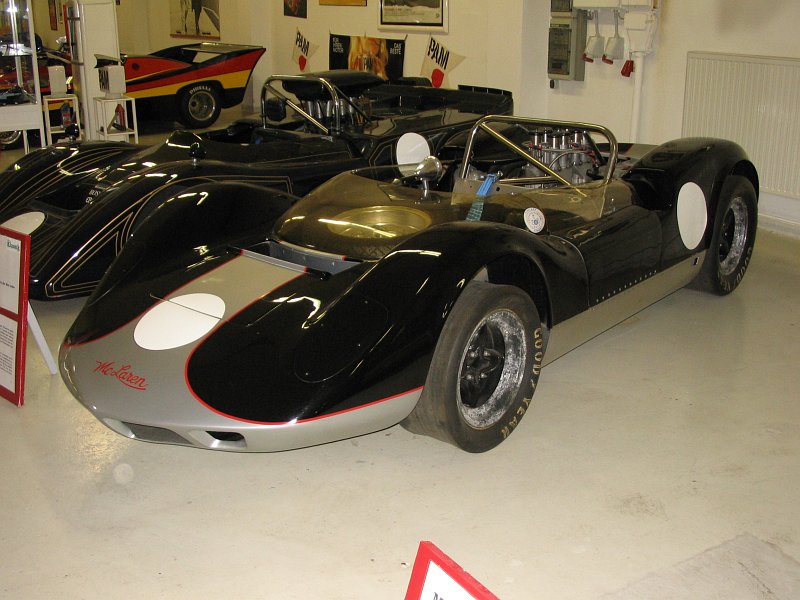
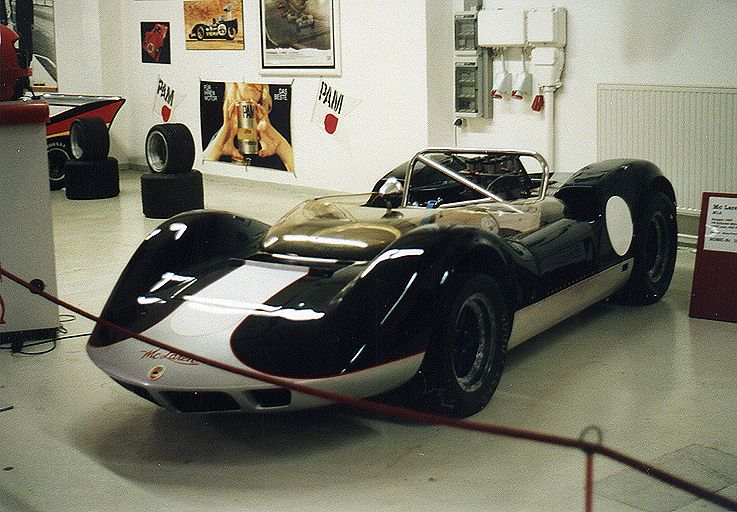
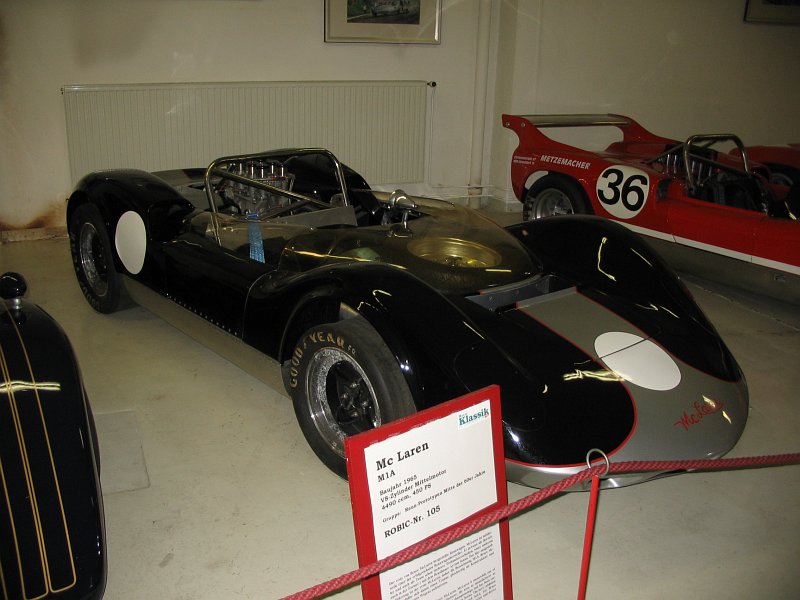
The M1A’s bodywork was clean, low and functional. The car followed the classic mid-60s sports-prototype style: a long, smooth nose with a deep central air intake, curved fenders over exposed wheels and a short, abrupt tail. The design prioritised low drag and effective cooling for the V8 engine, with additional ducting incorporated to manage temperatures during long race stints. The result was a car that looked modern and competitive even against more established constructors. Although early M1As lacked aerodynamic downforce devices, their shape offered good stability at high speeds.
Inside, the M1A was a pure competition machine. The cockpit was sparse, fitted only with essential gauges, a simple steering wheel and basic seating. Weight saving was the guiding principle; McLaren removed any unnecessary component that did not contribute to performance. Despite the minimalism, the driving position was well considered, allowing drivers to operate the car with precision during long and demanding races.
On the track, the McLaren M1A Oldsmobile proved to be a fast, balanced and durable racer. Its low weight and lively V8 power allowed strong acceleration out of corners and impressive top-end speed. The suspension provided predictable handling and good feedback, essential qualities for a driver like McLaren, who valued balance and control over brute force. The car quickly attracted attention for its competitiveness, securing strong results in British and North American events. Privateer teams also began purchasing M1As, providing valuable income and further establishing McLaren as a constructor.
The success of the M1A led directly to its successors, the M1B and eventually the M1C, which were refined and strengthened for the increasingly demanding North American sports-car scene. These developments helped prepare McLaren for its eventual dominance of the Can-Am series, where the brand became synonymous with innovation, speed and engineering excellence.
Today the McLaren M1A Oldsmobile is regarded as one of the most important early McLaren cars. As the company’s first true racing construction, it embodies the beginning of the McLaren philosophy: lightweight engineering, intelligent design and competitive performance achieved through clear, purposeful thinking. Surviving examples are rare and highly valued by collectors, representing not only a significant milestone in McLaren’s history but also a key chapter in the evolution of 1960s sports-prototype racing.